Is My Self-Worth Tied to My Weight?
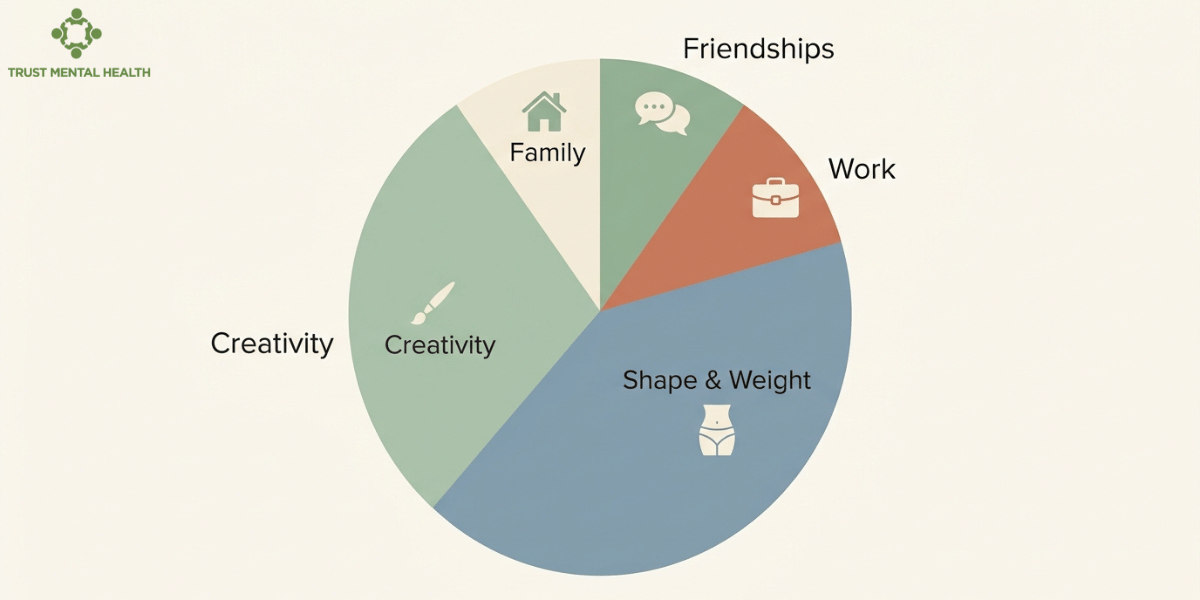
This post walks through the self-evaluation pie chart, a CBT-E exercise that shows how much of your self-worth depends on your weight and shape compared to everything else in your life. It covers why this pattern develops, why it matters for eating disorder recovery and relapse risk, and how to start rebalancing your sense of self-worth beyond your body.
Have you ever had a good day turn bad because of a number on a scale, or a comment about your body? If so, you're not alone, and there's actually a name for what's happening. It's one of the core ideas behind CBT-E, the eating-disorder-specific therapy we introduced in our last post, and it comes with a simple exercise that tends to make things click for people almost instantly.
Maybe it was a pair of jeans that fit differently than they used to. Maybe it was a passing comment at a family dinner, or a photo someone tagged you in that you wish they hadn't. Whatever the trigger, the effect can be the same: one small thing about your body takes over, and everything else you accomplished that day, every good conversation and every small win, gets pushed out of the way.
If you're in California and want support working through this, Trust Mental Health offers eating disorder therapy services that can help.
Why Does This Happen?
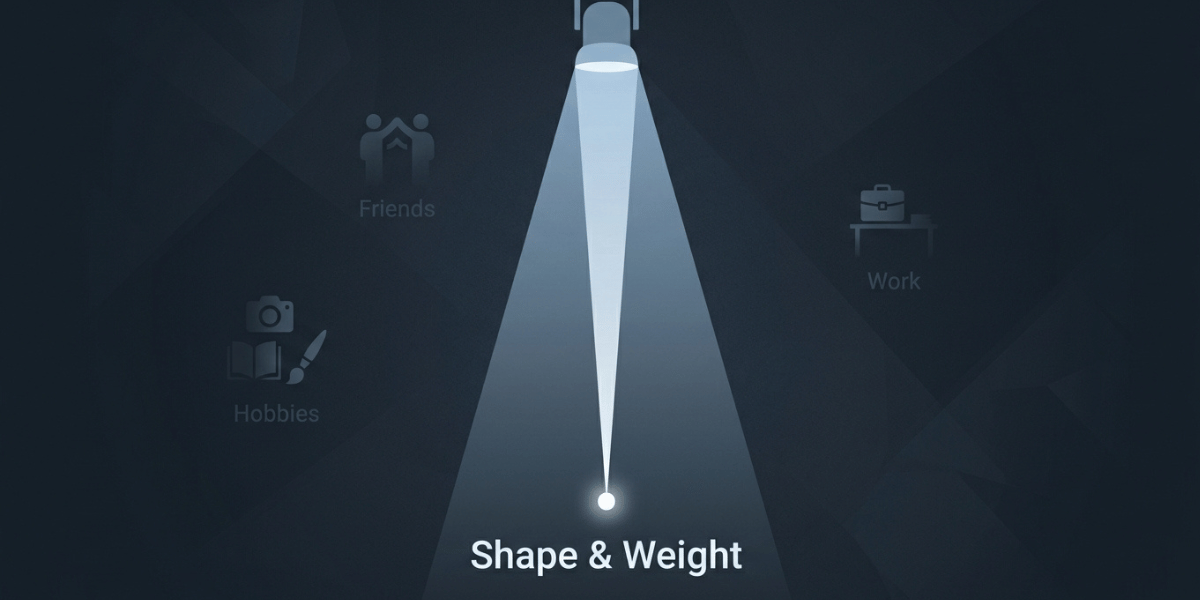
For a lot of people with eating disorders, self-worth has narrowed down to almost one thing: shape and weight. Other parts of life that used to matter, like friendships, work, or hobbies, quietly lose their influence over how someone feels about themselves.
This doesn't happen because someone is vain or shallow. It happens gradually, often starting with something as ordinary as a diet or a comment about appearance, and slowly taking up more space until it's doing most of the work of deciding whether a day feels good or bad.
Clinicians sometimes call this overvaluation of shape and weight, and it's considered one of the core mechanisms that keeps an eating disorder going. It's not just a symptom sitting alongside the eating disorder. It's closer to the engine driving it. Once shape and weight become the main measuring stick for self-worth, the eating disorder behaviors (restricting, bingeing, purging, over-exercising) start to feel like the only reliable way to feel okay about yourself, even when they're actively making things worse.
This is also why eating disorders can be so hard to talk yourself out of. Reasoning with someone about the health risks of restriction rarely works if their entire sense of worth is riding on the number on the scale. The logic of the eating disorder isn't really about food. It's about self-worth, and that's exactly what the pie chart exercise is designed to make visible.
I often see this shift happen so gradually that clients don't initially recognize it as a change in their sense of self-worth. It may begin with something that feels relatively harmless: a diet, a desire to feel healthier, a comment about their appearance, or increased attention to what they eat. Over time, though, thoughts about shape, weight, food, and comparison can start taking up more mental space. A particularly meaningful moment in therapy is when a client begins to notice that their mood or sense of worth is being determined almost entirely by what they see on the scale, how their body looks, or whether they believe they've "done well" with food that day. Sometimes the realization is as simple as, "I hadn't noticed how much my entire day depended on how I felt about my body that morning." That recognition can be an important turning point, because it creates space to explore who they are beyond shape and weight and begin rebuilding other sources of self-worth.
What Is the Self-Evaluation Pie Chart Exercise?
The pie chart exercise is a simple visual tool that shows how much weight and shape are actually influencing your sense of self-worth, compared to everything else in your life. It's used in CBT-E to make an invisible pattern visible.
Here's how it works. You list the things that affect how you feel about yourself: maybe it's family, friendships, work, faith, or creativity. Then you size each one like a slice of a pie, based on how much it actually shapes your day-to-day self-esteem, not how much you think it should. For a lot of people, once shape and weight go on the list, that slice ends up taking up more than half the pie.
From Meline Yavryan, AMFT: "The first time clients complete the pie chart, they are often surprised by how much of their self-worth is tied to weight, shape, or appearance. Seeing it visually can help them recognize that something they may have thought about only occasionally is actually influencing how they feel about themselves daily. I introduce the exercise gently and without judgment, encouraging clients to simply notice what they see and reflect on which areas of their lives have become smaller or less important over time. From there, we can discuss their desired pie chart composition and begin finding realistic ways to bring more balance into their lives."
How Do I Know If My Self-Worth Is Too Concentrated in One Area?

A good sign is asking what happens to your mood on a day when you feel like you've gained weight or don't like how you look. If that one thing can wreck an otherwise good day, regardless of what else happened, that's worth paying attention to.
A few other signs worth noticing:
You've pulled back from friends, hobbies, or activities you used to enjoy because they've started to feel secondary.
Your mood seems to track your body more closely than it tracks your actual life.
You can't easily name five other things that meaningfully shape how you feel about yourself.
A compliment about your appearance can turn your whole day around, while a compliment about your work or character barely registers.
You find yourself checking mirrors, scales, or photos throughout the day to see where you "stand."
Plans get canceled or reshuffled around how you feel about your body that day, not around what you actually want to do.
None of these signs mean something is broken about you. They're the natural result of a system that's been narrowed down to one input for a long time. The pie chart exercise exists to widen that system back out, not to shame anyone for how it got so narrow in the first place.
What Happens When Weight or Shape Takes Up Too Much of the Pie?
When self-worth is concentrated this heavily in one area, it tends to keep the eating disorder going, and it's linked to a higher risk of relapse even after someone has made real progress.
A 2024 study following patients who had successfully stopped binge eating found that this specific pattern, self-worth being overly tied to shape and weight, predicted relapse a year later, even in people who were doing well right after treatment. In plain terms: shrinking this slice of the pie isn't a side detail in recovery. It's one of the factors most connected to whether progress actually holds.
I try to hold relapse risk as information, not a prediction. I might say: "Knowing that this particular pattern can increase relapse risk doesn't mean relapse is waiting for you around the corner. It gives us a useful place to keep practicing. Recovery isn't about getting to a point where you never care about your body or never have a difficult thought again. It's about making those thoughts less powerful and less central to how you decide what you're worth or how you treat yourself."
I also like to reframe progress away from "Do I still have these thoughts?" and toward "What do I do when I have them?" Someone can make significant progress while still noticing body dissatisfaction, wanting reassurance about their weight, or having an occasional urge to return to old behaviors. The progress might be that they don't act on the thought, recover more quickly, recognize the eating-disorder voice sooner, or choose their values over the urge. That makes relapse prevention feel less like "I have to get this perfectly right or I'll relapse," and more like "I'm building more and more ways to respond when the old pattern shows up."
A Note on the Research
Grilo, C.M., Ivezaj, V., & Gueorguieva, R. (2024). Overvaluation of shape/weight at posttreatment predicts relapse at 12-month follow-up after successful behaviorally-based treatment of binge-eating disorder. International Journal of Eating Disorders. Study details
Can I Actually Change How My Pie Chart Looks?
Yes. The slices aren't fixed, and change usually happens by resizing them, not by pretending shape and weight don't matter at all. Most people don't end up erasing that slice completely. They shrink it and let other parts of life grow back into the space it used to take up.
After the first version of the pie chart, the next step is drawing a second one: not how things actually are, but how you'd want your self-worth to be distributed in recovery. That second chart becomes something to work toward, not just a hope, but an actual target you and a therapist can build a plan around.
What Would It Look Like to Rebalance My Self-Worth?

Rebalancing usually starts small: picking one or two activities that reconnect you to a part of life that's shrunk, and doing them consistently enough that they start to matter again. Activities that involve other people tend to work better than solo ones, since they're easier to stick with.
That might look like joining a weekly class instead of committing to something solo and easy to skip, or setting aside ten minutes a few times a week to reconnect with friends you've drifted from. Small and repeatable beats big and unsustainable here.
It helps to pick something that existed before the eating disorder took over, even if it feels rusty or awkward at first. Maybe that's an instrument you used to play, a sport you used to enjoy, or a friend group you used to be part of. You're not starting from nothing. You're reopening a door that's still there, even if it hasn't been used in a while.
It's also worth expecting some resistance from the eating disorder itself. Rebuilding other slices of the pie chart can feel threatening, because it means shape and weight no longer get to run the whole show. That resistance is normal, and it's a sign the exercise is working, not a sign to stop.
From Kim Shimazaki, AMFT: "For example, the client might reengage with drawing, an interest they identified in our intake session, on an increased and planned regular basis. If it doesn't stick, I could help her reevaluate what might stick or find a way to help her be consistent with drawing (put it in her phone alarm or involve a friend, etc.). My approach would be to 'lead from behind,' so to speak, and support them in creating the plan."
Is This Exercise Only for People with Eating Disorders?
No. This pattern shows up any time someone's identity has narrowed down to one measurable thing, and eating disorders are just one common example. It's common in athletes whose entire sense of self rides on their sport, or in anyone whose self-worth has quietly become dependent on one relationship, role, or achievement.
It's especially common in female athletes, whose sense of self is often built almost entirely around performance and appearance in their sport. This also overlaps with what we've written about body positivity in relationships and body dysmorphia, both of which touch on this same pattern of self-worth becoming overly tied to appearance, even without a formal eating disorder diagnosis.
You might also recognize this pattern in a parent whose entire identity has folded into their children's achievements, or a professional whose sense of self rises and falls with each performance review. The pie chart exercise works the same way in any of these situations. You're not trying to erase the slice that matters to you. You're making sure it isn't the only slice left standing.
How Do I Get Started If This Resonates With Me?
A good first step is trying the pie chart exercise yourself, even informally, and noticing what comes up. You don't need a diagnosis to benefit from seeing this pattern more clearly, and you don't have to figure out what to do with it alone.
Grab a piece of paper and draw a circle. List out what actually shapes your sense of self-worth day to day, not what you think should shape it. Size each slice honestly. Most people are surprised by what the pie chart shows them, and that surprise is often the first real step toward change.
Whether you're driving down El Camino Real toward Mountain View, parked outside our office on The Alameda in San Jose, or grabbing coffee near Hamilton Avenue in Campbell before an appointment, this pattern shows up the same way for people across the Bay Area. Our therapists in San Jose, Palo Alto, Fremont, Mountain View, Campbell, and San Francisco see it constantly in session, and it's genuinely treatable.
If this is sounding familiar, our earlier post on what CBT-E actually involves walks through how this exercise fits into the bigger picture of treatment. And since food and mental health are closely connected, you may also find our post on nutrition and mental health helpful as a next read.
If you're noticing that your self-worth has narrowed down to your weight or shape, you don't have to sort that out on your own. Our California-based therapists offer a free consultation to talk through what you're experiencing, no pressure involved. We see clients across our Bay Area offices in San Jose, Palo Alto, Fremont, Mountain View, Campbell, and San Francisco, with online therapy available throughout California. Learn more about our eating disorder therapy services, or book an appointment directly when you're ready.
